
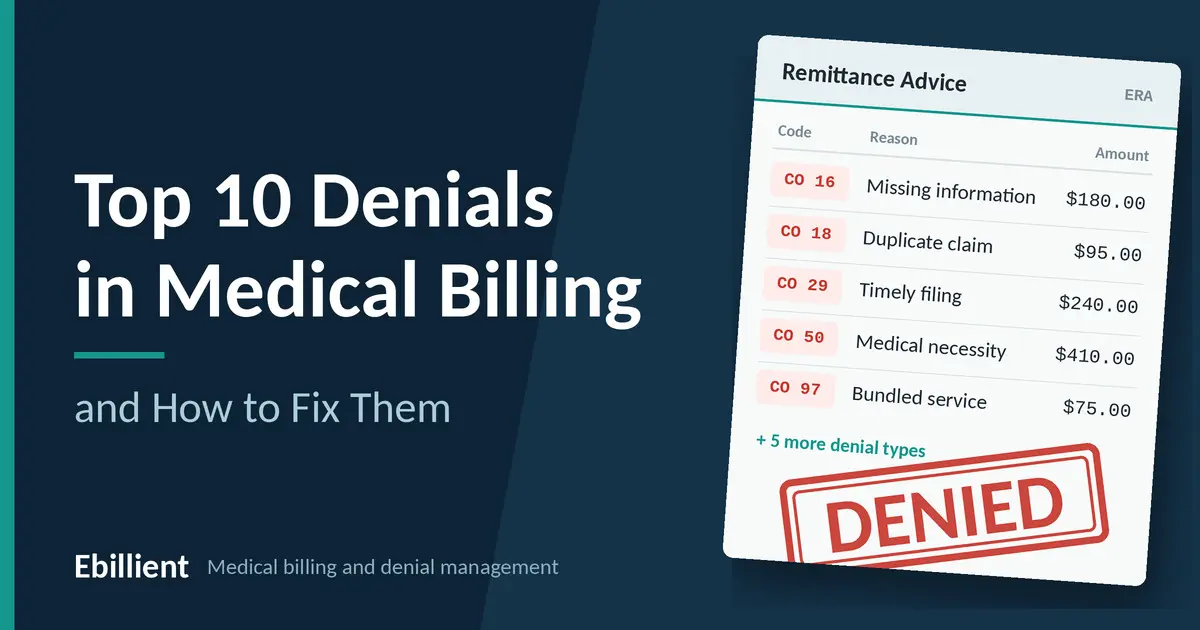
A denied claim means your practice has already delivered the care but is still waiting to be paid. Every denial adds rework, delays cash flow, and pulls your team away from other work. Understanding the top 10 denials in medical billing is the first step toward stopping revenue leaks before they grow.
This guide explains what a claim denial is, how to read denial codes in medical billing, and what causes the ten most common denials. For each one you will find a clear fix and a way to prevent it from happening again.
What Is a Claim Denial?
A claim denial happens when an insurance payer processes a claim and refuses to pay for all or part of it. The payer sends the reason on the Electronic Remittance Advice (ERA) or Explanation of Benefits (EOB), usually as a coded message.
Denial vs. Rejection
These two terms are often mixed up, but they are different problems.
A rejection happens before the claim is fully processed. The clearinghouse or the payer’s front end catches a formatting or data error, such as a missing field or an invalid ID. The claim never enters adjudication, so you can correct it and resubmit without an appeal.
A denial happens after the payer has processed the claim and decided not to pay. Fixing it usually means correcting the claim or filing a formal appeal, depending on the reason.
Knowing which one you are dealing with saves time, because each follows a different workflow. For a deeper look at the front end problem, read our guide on why medical claims get rejected.
Denial Codes in Medical Billing: CARC and RARC Explained
Every denial on a remittance comes with codes that explain what happened. Two code sets work together.
CARC (Claim Adjustment Reason Code): Explains why the payer adjusted or denied a claim or service line.
RARC (Remittance Advice Remark Code): Adds detail that clarifies the CARC, such as which piece of information was missing.
Group Codes
Each CARC is paired with a group code that tells you who is responsible for the amount.
- CO (Contractual Obligation): The provider is responsible, and the amount usually cannot be billed to the patient.
- PR (Patient Responsibility): The amount belongs to the patient, such as a deductible, coinsurance, or copay.
- OA (Other Adjustment): An adjustment that does not fit the other groups.
- PI (Payer Initiated Reductions): The payer reduced the payment based on its own policy.
Tip: Read the group code first. It immediately tells you whether the balance is a provider problem, a patient balance, or something else.
Top 10 Denials in Medical Billing
Below are the ten denials billing teams see most often. Each one lists the code, the usual cause, the fix, and the prevention step.
1. Missing or Incorrect Claim Information (CO 16)
What it means: The claim is missing information or contains a submission or billing error.
Common causes: Wrong patient date of birth, misspelled name, incorrect member ID, missing NPI, or an incomplete diagnosis.
How to fix it: Check the RARC to find exactly what is missing, correct the data, and resubmit the claim as a corrected claim if the payer requires it.
How to prevent it: Verify demographics at every visit and run each claim through a claim scrubber before submission.
2. Duplicate Claim (CO 18)
What it means: The payer received a claim or service line that matches one it has already processed.
Common causes: Submitting the same claim twice, resubmitting before the payer has responded, or billing the same service on two different claims.
How to fix it: Check the claim status and the remittance first. If the original was paid or is still pending, do not resubmit. If the payer denied the first one for another reason, work that reason instead.
How to prevent it: Set a standard waiting period before any resubmission and track claim status in your billing system.
3. Timely Filing Limit Expired (CO 29)
What it means: The claim was submitted after the payer’s filing deadline.
Common causes: Delayed charge entry, slow follow up on rejections, or lost claims that were never tracked.
How to fix it: Gather proof of timely filing, such as a clearinghouse acceptance report, and file an appeal. Without proof, these denials are very hard to overturn.
How to prevent it: Record each payer’s filing limit. Medicare generally allows one year from the date of service, while commercial payers often allow anywhere from 90 days to a year. Work rejections within days and monitor claims that have not been acknowledged.
4. Lack of Medical Necessity (CO 50)
What it means: The payer decided the service was not medically necessary based on the diagnosis submitted.
Common causes: A diagnosis that does not support the procedure, thin clinical documentation, or a service that does not meet the payer’s coverage policy.
How to fix it: Review the medical record, confirm the diagnosis and procedure are linked correctly, and file an appeal with supporting clinical notes and any relevant guidelines.
How to prevent it: Check payer coverage policies before scheduling high cost services and train providers to document the clinical reason for each service.
5. Missing or Invalid Prior Authorization (CO 197 and CO 15)
What it means: CO 197 means the required authorization was absent. CO 15 means the authorization number is missing, invalid, or does not match the billed service or provider.
Common causes: No authorization requested, an expired authorization, or a mismatch between the authorized and billed codes.
How to fix it: Contact the payer to ask about a retroactive authorization, which some payers allow in limited cases. If the authorization exists, correct the number and resubmit.
How to prevent it: Confirm authorization requirements when the appointment is scheduled. Our prior authorization services handle this step before the patient is seen.
6. Bundled or Unbundled Services (CO 97)
What it means: The payer considers the service part of the payment for another procedure already processed.
Common causes: Billing separately for services that are included in a primary procedure, missing modifiers, or ignoring National Correct Coding Initiative (NCCI) edits.
How to fix it: Review the NCCI edits for the code pair. If the service was truly separate and distinct, add the correct modifier and appeal with documentation. If not, accept the adjustment.
How to prevent it: Use coding software that flags bundling edits, and apply modifiers only when the documentation supports them. See our list of common CPT coding mistakes for more examples.
7. Coverage Terminated or Patient Not Found (CO 27 and CO 31)
What it means: CO 27 means the expenses were incurred after coverage ended. CO 31 means the payer could not identify the patient as its insured.
Common causes: Patient changed insurance, coverage lapsed, or the member ID or name does not match payer records.
How to fix it: Re verify eligibility for the date of service. If the patient has new coverage, bill the correct payer. If there is no coverage, transfer the balance to the patient according to your policy.
How to prevent it: Verify eligibility before every visit, not just the first one. Our insurance verification services help stop these denials at the front desk.
8. Coordination of Benefits Issues (CO 22)
What it means: The payer believes another insurance plan is primary for this claim.
Common causes: Outdated insurance information, incorrect primary and secondary order, or patients with more than one plan who have not updated their records.
How to fix it: Ask the patient to confirm all active coverage, contact the payers to determine the correct order, update your records, and rebill the primary payer first.
How to prevent it: Ask about other coverage at every visit and update the patient file whenever coverage changes.
9. Claim Sent to the Wrong Payer (CO 109)
What it means: The payer says the claim is not covered by them and should go to a different payer or contractor.
Common causes: Choosing the wrong plan in the system, confusing a commercial plan with a Medicare Advantage plan, or sending a workers compensation or auto claim to health insurance.
How to fix it: Identify the correct payer through eligibility verification and submit the claim to them before their filing limit runs out.
How to prevent it: Confirm the payer name and plan type from the insurance card and eligibility response every time.
10. Modifier and Diagnosis Coding Errors (CO 4 and CO 11)
What it means: CO 4 means the procedure code is inconsistent with the modifier used, or a required modifier is missing. CO 11 means the diagnosis does not match the procedure.
Common causes: Wrong or missing modifiers, outdated codes, or a diagnosis that does not support the service billed.
How to fix it: Review the documentation, correct the modifier or diagnosis code, and resubmit.
How to prevent it: Update coding references every year, run regular coding reviews, and consider billing and coding audits to catch patterns early.
Not Every Adjustment Is a True Denial
Two very common codes appear on almost every remittance but are usually not problems.
- CO 45 means the charge exceeds the contracted or fee schedule amount. It is normally a routine contractual write off, not a denial to appeal.
- PR 1, PR 2, and PR 3 represent the patient’s deductible, coinsurance, and copay. These are balances to bill the patient, not payer errors.
Separating these from real denials keeps your team from wasting time on appeals that do not apply.
Medical Billing Denial Codes and Solutions: Quick Reference
Use this table as a fast lookup when you are working a remittance.
| Code | Meaning | Common Cause | Solution |
| CO 16 | Missing or incorrect information | Data entry errors | Correct data and resubmit |
| CO 18 | Duplicate claim | Same claim sent twice | Check status before resubmitting |
| CO 29 | Timely filing expired | Late submission | Appeal with proof of timely filing |
| CO 50 | Not medically necessary | Weak documentation or diagnosis link | Appeal with clinical notes |
| CO 197 | Authorization absent | No prior authorization | Request retroactive approval if allowed |
| CO 15 | Authorization invalid | Wrong number or service | Correct number and resubmit |
| CO 97 | Included in another service | Bundling or missing modifier | Review NCCI edits and add modifier if supported |
| CO 27 | Coverage terminated | Lapsed insurance | Verify eligibility and bill the correct party |
| CO 31 | Patient not identified | ID or name mismatch | Verify member details |
| CO 22 | Coordination of benefits | Wrong payer order | Confirm primary and secondary coverage |
| CO 109 | Wrong payer | Incorrect plan selected | Send to the correct payer |
| CO 4 | Modifier issue | Missing or wrong modifier | Correct the modifier |
| CO 11 | Diagnosis mismatch | Diagnosis does not support the procedure | Correct the diagnosis code |
How to Work a Denied Claim Step by Step
Having a repeatable process helps your team recover payments faster. Here is a simple workflow for handling any of the medical claim denial codes above.
- Read the remittance. Identify the group code, the CARC, and any RARC.
- Decide the path. Choose between correcting and resubmitting the claim or filing an appeal.
- Find the root cause. Look at coding, documentation, eligibility, or authorization to see what went wrong.
- Act before the deadline. Submit the corrected claim or appeal within the payer’s time limit.
- Track and learn. Log the denial reason so you can spot patterns and fix them at the source.
Appeal Basics
Appeal deadlines differ by payer. Medicare generally allows 120 days from receiving the initial determination to request a first level appeal, while commercial payers set their own limits, often ranging from 60 to 180 days. Always check the payer’s current rules before you submit. A strong appeal includes the claim details, the denial reason, a short explanation, and supporting documentation such as clinical notes or authorization records.
How to Prevent Claim Denials
Most denials can be avoided. Focus on these five habits.
- Verify insurance twice. Check eligibility when the appointment is scheduled and again at check in.
- Secure authorizations early. Confirm requirements and get approvals before the service.
- Scrub every claim. Use a claim scrubber to catch errors before submission.
- Keep coding current. Train your staff on yearly coding and payer policy updates.
- Review denial trends monthly. Track which codes appear most often and fix the underlying process.
Stop Losing Revenue to Claim Denials with Expert Denial Management
Frequently Asked Questions
What are the most common denial codes in medical billing?
The most common include CO 16 (missing information), CO 18 (duplicate claim), CO 29 (timely filing), CO 50 (medical necessity), CO 97 (bundled service), and CO 197 (missing authorization).
What is the difference between a claim denial and a claim rejection?
A rejection is caught before the payer processes the claim and can usually be corrected and resubmitted. A denial happens after processing and often requires a correction or an appeal.
What does CO mean in a denial code?
CO stands for Contractual Obligation. It means the provider is responsible for the adjusted amount and generally cannot bill the patient for it.
How long do you have to appeal a denied claim?
It depends on the payer. Medicare generally allows 120 days for a first level appeal, and commercial payers vary widely. Always confirm the deadline in the denial letter or payer policy.
What is a good claim denial rate?
Many billing professionals aim to keep the denial rate below 5 percent, though the ideal number depends on your specialty and payer mix. Tracking your own rate monthly matters more than comparing to a single benchmark.
Should small practices outsource denial management?
Many small practices do, because tracking payer rules, appeals, and deadlines takes dedicated time. An experienced billing partner can work denials faster and fix the root causes so fewer claims are denied in the first place.
Conclusion
The top 10 denials in medical billing, from missing information to authorization gaps and coding errors, are largely preventable. When your team understands denial codes in medical billing and follows a clear process for fixing and preventing them, you recover more revenue and spend less time on rework.
If denials and aging accounts receivable are holding your practice back, our team can help. Ebillient builds its workflows around a 97% first pass clean claim rate, with dedicated denial and AR follow up so nothing falls through the cracks.
Ready to find out where you are losing revenue? Request your free billing audit and get clear, actionable findings with no obligation.
You can also explore our AR and denial management services to see how we recover revenue from denied and aging claims.