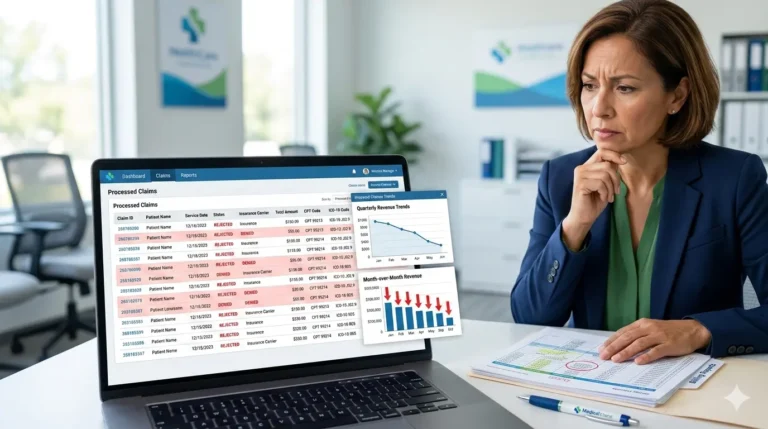

CPT 99204 is a Level 4 new patient office visit code used when a provider delivers moderate complexity medical decision-making or spends 45 to 59 minutes on the encounter date. It is one of the most frequently billed Evaluation and Management (E/M) codes, and one of the most commonly downcoded or denied by insurance payers.
When documentation does not clearly support moderate complexity, practices risk lost reimbursement, claim denials, and increased Accounts Receivable (AR) days. Proper billing of CPT code 99204 is not just about compliance. It directly affects Revenue Cycle Management (RCM), cash flow, and audit protection.
Managing high-level E/M codes like CPT 99204 requires structured oversight across the entire revenue workflow, which is why many practices rely on professional Revenue Cycle Management (RCM) services to prevent revenue leakage and improve cash flow stability.
This guide explains CPT 99204 billing requirements, documentation standards, 2026 reimbursement updates, and how professional medical billing services help prevent costly revenue mistakes.
What Is CPT Code 99204?
CPT 99204 represents a Level 4 office or outpatient visit for a new patient.
It is reported when:
- The patient qualifies as new under the 3-year rule
- The visit involves moderate complexity medical decision-making (MDM)
OR - The provider spends 45–59 minutes total time on the date of the encounter
Following the 2021 E/M guideline changes, code selection is no longer based on detailed history and physical exam scoring. Instead, the visit level is determined by either medical decision-making or total provider time.
This shift simplified documentation requirements, but increased the importance of clearly describing clinical complexity and risk.
The New Patient Rule: A Common Source of Revenue Loss
Before billing 99204, practices must confirm the patient meets the definition of a new patient.
A patient is considered new if they have not received professional services from the same physician or another physician of the same specialty within the same group practice during the past three years.
Incorrectly billing a patient as new can lead to:
- Claim denials
- Payment recoupment
- Audit flags
- Increased AR days
Many practices lose revenue simply because patient status is not verified correctly during insurance verification and scheduling.
Working with reliable Insurance Verification services helps ensure patient eligibility and coverage details are confirmed before claims are submitted, reducing preventable denials.
Medical Decision-Making Requirements for CPT 99204
Moderate complexity MDM is the most common pathway for selecting 99204.
To qualify, documentation must meet two of the following three elements at the moderate level:
1. Number and Complexity of Problems Addressed
Examples that may qualify include:
- Two or more stable chronic illnesses
- One chronic illness with exacerbation
- An undiagnosed new problem with uncertain prognosis
- Acute illness with systemic symptoms
The documentation must clearly explain the status of each condition and management decisions.
Simply listing diagnoses is not enough.
2. Amount and Complexity of Data Reviewed
Moderate data review may include:
- Reviewing external records
- Ordering and interpreting diagnostic tests
- Independent analysis of lab results
- Discussion with another healthcare professional
If this is not clearly documented, payers often downcode to 99203.
3. Risk of Complications and Morbidity
Moderate risk commonly includes:
- Prescription drug management
- Adjustment of medications
- Management of chronic disease progression
- Decisions regarding minor procedures with risk factors
Prescription drug management alone may support moderate risk, but documentation must reflect the clinical reasoning behind decisions.
Time-Based Billing Option for CPT 99204
Providers may select CPT 99204 based on total time spent on the encounter date.
The qualifying time range is 45 to 59 minutes.
Total time includes:
- Reviewing records
- Evaluating the patient
- Counseling and education
- Ordering medications or tests
- Coordinating care
- Documenting the visit
Time must be clearly documented.
A vague statement such as “spent significant time” is not sufficient. The exact total time must be recorded.
Failure to document time properly is a leading cause of downcoding.
2026 Medicare Reimbursement for CPT 99204
Reimbursement varies by region and payer.
On average, Medicare reimbursement for CPT 99204 ranges between approximately $160 and $180, depending on locality adjustments and annual conversion factors.
Payment is based on:
- Work RVU
- Practice Expense RVU
- Malpractice RVU
Commercial insurance contracts may reimburse higher amounts.
However, reimbursement means nothing if claims are denied or downcoded.
Many practices believe they are billing correctly, until they analyze denial patterns and discover revenue leakage.
How CPT 99204 Errors Impact Revenue Cycle Management
Incorrect billing of 99204 affects the entire revenue cycle.
Common financial impacts include:
- Downcoding from 99204 to 99203
- Increased claim denials
- Delayed payments
- Higher AR days
- Audit exposure
- Recoupments
Even a small percentage of downcoded Level 4 visits can result in significant annual revenue loss.
For example, if a practice bills 200 Level 4 visits per month and 15% are downcoded, the revenue difference adds up quickly over a year.
Without proper denial tracking and coding audits, these losses often go unnoticed.
Top Reasons CPT 99204 Claims Get Denied
Medical billing data shows common denial causes include:
- Insufficient documentation of moderate MDM
- Incorrect patient classification
- Missing or unclear time statements
- Lack of medical necessity
- Failure to meet payer-specific policies
- Incorrect place of service
Denial management requires more than resubmission. It requires root-cause analysis and prevention strategies.
This is where expert Accounts Receivable (AR) and Denial Management support becomes essential to track trends, correct recurring errors, and recover lost revenue quickly.
CPT 99204 vs 99203 vs 99205: Why Proper Level Selection Matters
Selecting the correct level is critical.
CPT 99203 involves low complexity decision-making and 30–44 minutes of total time.
CPT 99205 represents high complexity decision-making and 60–74 minutes.
Choosing the wrong level can result in:
- Underbilling and lost revenue
- Overbilling and audit risk
- Compliance violations
Accurate coding protects both revenue and regulatory standing.
How Medical Billing Services Protect High-Level E/M Claims
High-level E/M codes like 99204 require precision.
Professional medical billing services strengthen performance by:
- Verifying patient status before scheduling
- Ensuring proper insurance eligibility checks
- Conducting pre-bill coding reviews
- Performing regular billing and coding audits
- Managing denials proactively
- Monitoring payer trends
- Tracking utilization patterns
When billing, coding, AR management, and compliance work together, practices see:
- Reduced denial rates
- Faster reimbursements
- Lower AR days
- Improved cash flow
- Reduced audit exposure
This is where comprehensive Revenue Cycle Management delivers measurable results.
The Role of Billing and Coding Audits
Internal audits are essential when billing CPT 99204. Partnering with professional Billing and Coding Audit services helps practices identify documentation gaps early and maintain compliance with payer requirements.
Audits help identify:
- Overuse or underuse of Level 4 visits
- Documentation gaps
- Risk scoring inconsistencies
- Template misuse
- Compliance vulnerabilities
Proactive audits protect against payer investigations and support HIPAA-compliant documentation standards.
Practices that perform routine coding audits typically experience fewer external audit challenges.
Why Insurance Verification and Prior Authorization Matter
Front-end processes significantly influence CPT 99204 reimbursement.
If insurance eligibility is not verified accurately, claims may be rejected before review.
If prior authorization requirements are missed for related services, reimbursement may be delayed.
Strong insurance verification and authorization workflows reduce preventable denials and improve first-pass claim acceptance rates.
Final Thoughts
CPT 99204 plays a critical role in outpatient medical billing. It reflects moderate complexity care and appropriate reimbursement for new patient visits.
However, inaccurate documentation, poor denial management, and weak front-end processes can quickly turn this high-value code into a source of revenue loss.
Medical practices that invest in professional medical billing and coding support see measurable improvements in:
- Claim accuracy
- Denial reduction
- AR performance
- Revenue stability
- Compliance protection
Managing high-level E/M services requires expertise across coding, billing, insurance verification, AR management, and compliance oversight.
If your practice is experiencing downcoding, delayed payments, or rising denials related to CPT 99204 or other E/M services, a comprehensive Revenue Cycle Management approach can help recover lost revenue and strengthen financial performance.