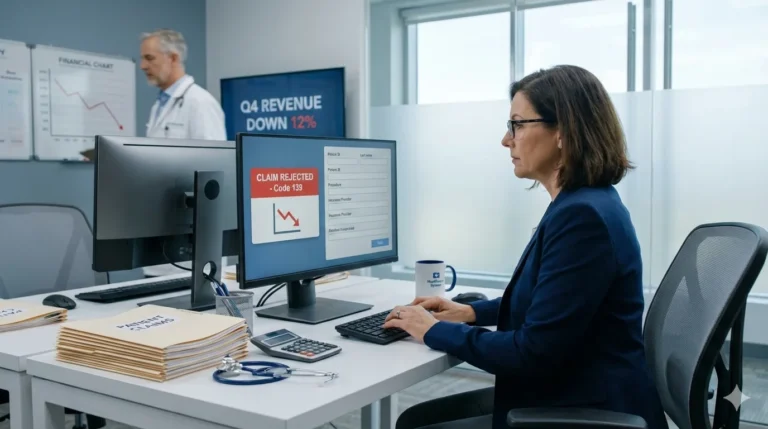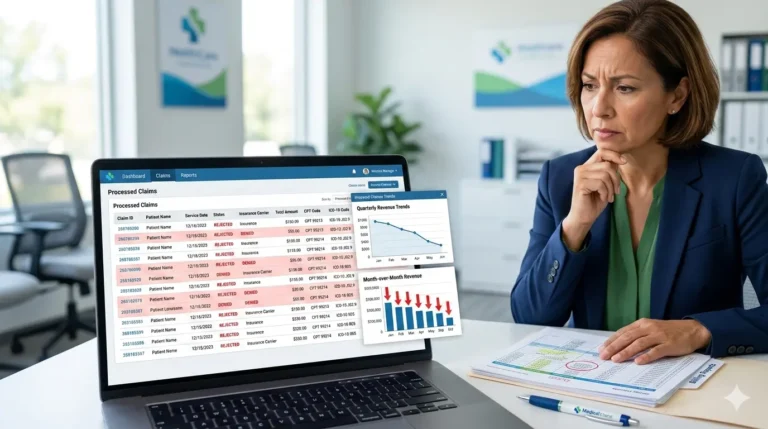

Charge capture is the process of recording every billable service a provider delivers, while charge entry is the step where those recorded services are translated into standardized billing codes and entered into the practice management system. Together, they form the backbone of your revenue cycle, and a breakdown in either one means money your practice has already earned simply does not get collected.
Why So Many Practices Confuse the Two
If you have ever sat in a billing team meeting and heard someone use “charge capture” and “charge entry” interchangeably, you are not alone. The confusion is understandable because the two processes sit right next to each other in the revenue cycle workflow. But treating them as the same thing is exactly the kind of operational blind spot that leads to claim denials, underpayments, and revenue leakage that quietly drains a practice’s bottom line year after year.
Understanding where one ends and the other begins is not just a matter of billing terminology. It is the difference between a healthcare organization that consistently captures its earned revenue and one that leaves tens of thousands of dollars on the table every single quarter.
What Is Charge Capture in Medical Billing
Charge capture is the clinical side of the revenue equation. It refers to the process of documenting, collecting, and recording every service, procedure, medication, supply, or encounter that a provider delivers to a patient. This documentation happens at the point of care, and it serves as the raw data that the entire billing process depends on.
In a traditional workflow, charge capture happened through paper superbills or encounter forms that physicians filled out after a patient visit. Today, most practices rely on electronic health record systems, charge capture software, or mobile charge capture tools that allow providers to log services in real time, often from a smartphone or tablet.
The key entities involved in charge capture include the treating physician or advanced practice provider, the EHR or charge capture platform, clinical documentation, and the documentation integrity team. Every CPT code, every ICD-10 diagnosis code, and every service unit must be accurately reflected at this stage, because anything that goes uncaptured here is gone for good.
Common charge capture failures include:
Services provided but never documented in the billing system, missed procedure codes when multiple services are delivered in a single visit, incorrect patient identification that causes charges to be logged under the wrong account, and delays in charge submission that push encounters past the payer’s timely filing window.
According to research published through healthcare revenue cycle organizations, the average provider loses between 1% and 3% of total revenue to charge capture failures alone. For a mid-sized multispecialty group, that number can translate to hundreds of thousands of dollars annually.
What Is Charge Entry in Medical Billing
Charge entry picks up exactly where charge capture leaves off. Once the clinical team has documented the services delivered, charge entry is the process by which the billing department takes that clinical documentation and translates it into the structured billing data that gets submitted to payers.
This involves entering procedure codes, diagnosis codes, modifiers, service dates, rendering provider information, place of service codes, and any other data elements required by a specific payer or claim type. Charge entry specialists work within the practice management system or billing platform to create clean claims that accurately reflect what the provider delivered.
The accuracy of charge entry directly determines whether a claim gets paid, rejected, or denied. A single transposed digit in a CPT code, a missing modifier, or an incorrect place of service code can result in an outright denial or a significant underpayment, both of which require costly rework through the appeals and resubmission process.
The core entities involved in charge entry include the medical billing specialist or charge entry team, the practice management system such as Kareo, AdvancedMD, athenahealth, or Epic, the claim scrubbing engine, payer fee schedules, and the coding compliance framework.

The Critical Differences Side by Side
Understanding the distinction clearly comes down to three dimensions: who does it, when it happens, and what the output looks like.
Who performs the work: Charge capture is primarily the responsibility of the clinical team, including physicians, nurses, and clinical documentation specialists. Charge entry is performed by the medical billing and coding team.
When it occurs in the workflow: Charge capture happens at or immediately after the point of care. Charge entry happens after clinical documentation is complete and the billing team reviews the encounter.
What the output is: Charge capture produces a documented record of services rendered. Charge entry produces a billable claim line ready for submission to the insurance payer.
Where errors cause the most harm: Errors in charge capture result in lost revenue because services were never recorded. Errors in charge entry result in denied or delayed claims because the recorded services were coded or entered incorrectly.
How Both Processes Affect Your Revenue Cycle
The revenue cycle is only as strong as its weakest link, and charge capture and charge entry are two of the most vulnerable points in the entire chain. The downstream effects of failures in either area touch virtually every other part of your billing operation.
When charge capture is inconsistent, your accounts receivable begins to fill with encounters that were partially documented or not documented at all. Your billing team cannot bill for what they cannot see. This is particularly common in hospital-based specialties like emergency medicine, hospitalist medicine, and critical care, where providers are moving quickly through high patient volumes and documentation can easily fall behind.
When charge entry is inaccurate, your denial rate climbs. According to the American Academy of Professional Coders, a significant percentage of claim denials are attributable to front-end billing errors, which includes incorrect charge entry. Each denied claim costs the practice time and money to correct, resubmit, and track through the payer’s appeals process. If your denial management workflow is not airtight, many of those claims simply age out and become uncollectible.
The connection between these two processes and your overall Revenue Cycle Management performance is direct and measurable. Practices that invest in tightening their charge capture and charge entry workflows consistently see improvements in clean claim rates, days in accounts receivable, and net collection ratios.
Optimize Your Revenue Cycle with Accurate Charge Capture & Charge Entry
Common Charge Capture Errors and How to Fix Them
The most frequent charge capture problems share a common root cause: the gap between clinical workflow and billing workflow. Providers are focused on patient care, and the administrative burden of accurate documentation can feel secondary in the moment.
The most damaging charge capture errors include late charges that miss timely filing deadlines, unbundled services that should have been captured under a single comprehensive code, missing ancillary charges for supplies or injections administered during a visit, and incomplete documentation that does not support the level of service billed.
Fixing these problems requires a combination of technology and process improvement. Real-time charge capture tools that integrate directly with your EHR reduce the lag between care delivery and documentation. Regular charge lag reports allow billing managers to identify providers or departments where charges are consistently submitted late. And structured charge capture audits, conducted monthly or quarterly, surface patterns of missed charges before they become entrenched habits.
Common Charge Entry Errors and How to Fix Them
Charge entry errors tend to be more technical in nature, rooted in coding knowledge gaps, system configuration issues, or inadequate claim scrubbing before submission.
The most common charge entry errors include incorrect CPT or HCPCS code selection, missing or incorrect modifiers such as the 25 modifier for significant and separately identifiable evaluation and management services, wrong place of service codes, mismatched diagnosis and procedure code combinations that trigger medical necessity denials, and failure to update fee schedules when payer contracts change.
Addressing charge entry errors requires ongoing coder education, particularly as CPT code sets are updated annually by the American Medical Association. It also requires a robust claim scrubbing process that catches errors before they reach the payer. Pairing experienced billing specialists with intelligent claim editing software dramatically reduces the volume of avoidable denials.
Our Medical Billing and Coding Services are designed specifically to address these vulnerabilities, combining certified coding expertise with technology-driven quality controls that catch errors at the source rather than after a denial has already been issued.
The Role of Technology in Modernizing Both Processes
Healthcare technology has fundamentally changed how charge capture and charge entry are performed, and practices that have not modernized their workflows are paying a real financial price for it.
On the charge capture side, platforms like Meditech, Epic, Cerner, and dedicated mobile charge capture applications allow providers to document services in real time using voice recognition, smart templates, and procedure-specific documentation guides. Some systems use artificial intelligence to analyze clinical notes and flag potential missed charges, essentially acting as a safety net beneath the provider’s own documentation.
On the charge entry side, practice management systems with integrated coding engines, charge master databases, and automated crosswalk tools reduce the manual burden on billing staff and decrease the likelihood of human error. Robotic process automation is beginning to play a role in high-volume charge entry workflows, particularly in large health systems processing thousands of claims per day.
The integration between EHR systems and billing platforms is arguably the single most important technological factor in minimizing the gap between charge capture and charge entry. When clinical documentation flows seamlessly into the billing workflow without manual rekeying, the opportunity for transcription errors drops significantly and claim submission timelines accelerate.
Why This Matters Specifically for Independent Practices and Medical Groups
Independent practices and physician-owned medical groups face a unique set of pressures around charge capture and charge entry. Unlike large hospital systems with dedicated revenue cycle departments, smaller practices often rely on a lean billing team or outsource their billing entirely. This makes the consequences of workflow breakdowns more acute because there are fewer people available to catch and correct errors in real time.
For specialties like orthopedic surgery, dermatology, cardiology, and behavioral health, where the coding complexity is high and payer-specific rules are numerous, even small charge entry errors can translate into substantial revenue losses over the course of a year. A single miscoded surgical procedure can result in a denial worth thousands of dollars.
The solution for many independent practices is to work with a specialized revenue cycle partner that brings both the coding expertise and the process infrastructure needed to manage charge capture and charge entry effectively. This is not just about outsourcing a clerical function. It is about applying professional-grade revenue cycle management to a set of processes that directly determine how much of your earned revenue you actually collect.
For a deeper look at how a full-cycle approach can improve your financial performance, explore how Revenue Cycle Management Services from Ebillient MedRevenue work to optimize every stage of your billing workflow.
Charge Capture and Charge Entry in the Context of Compliance
Both processes carry significant compliance implications that go beyond simple revenue impact. Overbilling resulting from inaccurate charge capture, such as billing for services that were not rendered or upcoding a level of service beyond what documentation supports, exposes a practice to audits, recoupments, and in serious cases, investigation under the False Claims Act.
Underbilling, which can result from conservative charge capture practices or failure to capture all billable services, represents its own form of compliance risk because it can be interpreted as a pattern of aberrant billing behavior during payer audits.
The Office of Inspector General actively monitors billing patterns for outliers, and practices that consistently bill at the highest or lowest levels of service relative to their peers may find themselves subject to additional scrutiny. Accurate, well-documented charge capture and clean, appropriately coded charge entry are your best protection against compliance exposure.
This is why the Healthcare Financial Management Association and other industry bodies consistently emphasize the importance of internal auditing, coder credentialing through organizations like AAPC and AHIMA, and clear documentation standards that align with CMS guidelines.
Building a Workflow That Connects Both Processes Seamlessly
The most effective approach to charge capture and charge entry is to treat them not as two separate departmental responsibilities but as a single integrated workflow with shared accountability for the outcome.
This means establishing a charge capture policy that defines documentation timelines, assigns responsibility for charge submission by role, and sets a maximum acceptable charge lag measured in business days. It means building a charge entry quality review process that uses both automated scrubbing and human audit to verify accuracy before claims are submitted. And it means creating a feedback loop between the billing team and the clinical team so that recurring errors are identified, communicated, and corrected at the source.
Regular reconciliation between the number of patient encounters in the scheduling system and the number of charges entered in the billing system is one of the simplest and most effective controls a practice can implement. If these two numbers do not match, something has fallen through the cracks, and that gap represents revenue waiting to be recovered.
You can read more about how leading healthcare organizations approach revenue cycle optimization through resources like the Healthcare Financial Management Association at hfma.org, which publishes extensive guidance on billing compliance and financial performance benchmarking.
Final Thoughts
Charge capture and charge entry are not interchangeable terms, and they are not interchangeable processes. One happens at the bedside; the other happens at the billing workstation. One records what care was given; the other turns that record into a payable claim. Both are essential, both are vulnerable to error, and both have a direct and measurable impact on your practice’s financial health.
Practices that understand the distinction and invest in getting both right consistently outperform those that treat revenue cycle management as a back-office afterthought. In an environment where payer complexity is increasing, reimbursement rates are under pressure, and administrative costs continue to rise, operational precision in your billing workflow is one of the most reliable competitive advantages you can build.
At Ebillient MedRevenue, we specialize in helping healthcare providers close the gap between the care they deliver and the revenue they collect. Whether the issue is upstream at charge capture or downstream at charge entry, our team has the expertise and the systems to identify where your revenue is slipping and build the processes to stop it.
Optimize Your Revenue Cycle with Accurate Charge Capture & Charge Entry