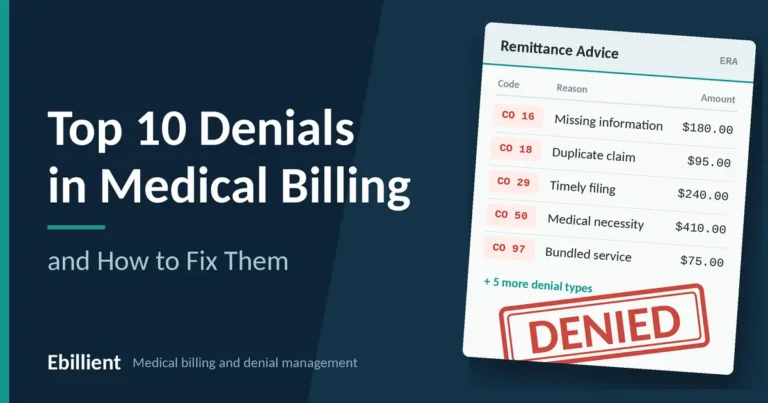

Every denied claim delays revenue and adds work for your staff. Most denials are preventable, and nearly all of them tell you exactly what went wrong if you know how to read the codes. This guide from Ebillient explains what denial codes mean, which ones matter most, how payers differ, and how to build a denial management process that protects your revenue.
What Are Denial Codes?
When a payer processes a claim, it sends back an electronic remittance advice (the 835 file) or a paper explanation of benefits. Adjustments on that remittance are explained with three kinds of codes:
- Group Codes show who is financially responsible for the adjustment. The most common are CO (Contractual Obligation, meaning the provider absorbs it), PR (Patient Responsibility), OA (Other Adjustment), and PI (Payer Initiated Reduction).
- Claim Adjustment Reason Codes (CARCs) explain why the payer adjusted or denied the amount. The official definitions are maintained by X12 in its Claim Adjustment Reason Codes list, so the meaning of a code is the same regardless of which payer sends it.
- Remittance Advice Remark Codes (RARCs) add detail to a CARC. For example, a CARC 16 is often paired with a RARC that names the exact missing field.
A complete denial reads as a group code plus a CARC, such as CO 16. To fix a denial you need to read all three parts together.
Why Denial Codes Matter
- Revenue impact. Every denial delays payment, and some become permanent write offs if deadlines pass.
- Cost to rework. Each denied claim needs staff time to research, correct, and resubmit.
- Patient billing accuracy. A PR code means you may bill the patient. A CO code usually means you may not. Getting this wrong creates compliance risk and patient complaints.
- Process insight. Denial patterns show where your front end, coding, or documentation is breaking down.
Categories of Denial Codes in Medical Billing
Eligibility and Coverage Issues
These occur when the patient’s coverage is inactive, the patient was not eligible on the date of service, the plan does not cover the service, or another payer is primary. Wrong subscriber details and coordination of benefits errors also fall here.
Coding and Documentation Errors
These include invalid or mismatched CPT, HCPCS, and ICD 10 codes, missing or wrong modifiers, unbundling, and documentation that does not support medical necessity or the level of service billed. Working with a team that provides accurate medical billing and coding services is one of the most direct ways to keep this category small.
Administrative or Process Errors
These are the avoidable mistakes: missing information, duplicate submissions, missed timely filing deadlines, absent prior authorization or referral, and wrong billing provider details such as NPI or taxonomy.
Payer Policy and Contractual Issues
These arise from payer specific rules, including bundling edits, frequency limits, site of service restrictions, network status, and fee schedule terms.
Standard Denial Codes Every Biller Should Know
CO 11: Diagnosis Inconsistent with Procedure
The diagnosis codes on the claim do not support the procedure billed.
Common causes: the diagnosis is not linked to the procedure, a less specific or incorrect ICD 10 code was used, or the diagnosis pointer order is wrong.
How to fix: review the encounter documentation, confirm the correct diagnosis and its link to the service, then submit a corrected claim.
CO 16: Claim/Service Lacks Information or Has Submission/Billing Errors
The claim was missing data or contained an error. This is one of the most frequent denials, and the payer often has not processed the claim on its merits.
Common causes: missing or invalid patient identifiers, absent NPI, incomplete referring provider data, missing modifiers, or formatting errors.
How to fix: read the accompanying RARC to see exactly what is missing, correct the data, and resubmit. Usually this needs a corrected or new claim, not an appeal.
CO 18: Exact Duplicate Claim/Service
The payer received the same claim or service more than once.
Common causes: resubmitting a claim before the first one was adjudicated, or sending the same charge on two claims.
How to fix: check claim status before resubmitting. If the original was paid or is in process, do nothing. If you are correcting a claim, submit it as a replacement with the proper frequency code rather than as a new claim. Be careful with legitimate repeat services, which may need a modifier such as 76 or 77 where appropriate.
CO 29: The Time Limit for Filing Has Expired
The claim was submitted after the payer’s timely filing deadline.
How to fix: the answer depends on the payer. With commercial plans and many Medicaid plans, gather proof of timely submission, such as clearinghouse acceptance reports or payer acknowledgment, and appeal. With Original Medicare, a claim denied for late filing is not treated as an initial determination, so it has no standard appeal rights. Medicare allows only limited exceptions, which are described in Section 70.7 of Chapter 1 of the Medicare Claims Processing Manual. Without proof or a qualifying exception, this denial is usually a write off, since the patient generally cannot be billed for a provider caused filing failure. Prevention through claim tracking is far more effective than appeal.
PR 1: Deductible Amount
The allowed amount was applied to the patient’s deductible.
Action: this is a valid payment outcome, not an error. Post the adjustment and bill the patient. Verify the amount matches the payer’s remittance and the patient’s benefits.
CO 50: Not Deemed a Medical Necessity by the Payer
The payer decided the service did not meet its medical necessity criteria. Note that noncovered charges are reported under CARC 96, so do not confuse the two.
Common causes: diagnosis does not meet the payer’s coverage policy, frequency limits exceeded, or documentation does not support necessity.
How to fix: review the payer’s medical policy or the Medicare National and Local Coverage Determinations, confirm documentation supports the service, and file an appeal with clinical records and a letter of medical necessity if warranted. For Medicare, an Advance Beneficiary Notice signed before the service, with modifier GA, is what allows you to bill the patient when you expect denial for necessity.
CO 97: Benefit Included in Payment for Another Service Already Adjudicated
The payer considers the service part of another procedure’s payment, which is a bundling denial.
Common causes: NCCI edits, a missing modifier such as 59 or an X modifier (XE, XS, XP, XU), or a service that is integral to the primary procedure.
How to fix: verify whether the services were truly distinct. If they were, and documentation supports it, add the appropriate modifier and appeal or submit a corrected claim. If they were not distinct, accept the adjustment. Do not bill the patient for a CO 97.
PR 2: Coinsurance Amount
The patient owes a percentage of the allowed amount after the deductible.
Action: valid adjustment. Post it and bill the patient according to the plan’s coinsurance rate.
PR 3: Copayment Amount
The patient owes a fixed copay.
Action: valid adjustment. Ideally collect the copay at the time of service, which improves collection rates considerably.
Payer Specific Rules for Denied Codes
Always confirm current rules in your provider contract and payer manuals, since deadlines and processes change.
Medicare Denial Rules
- Timely filing: Original Medicare fee for service claims must be filed within 12 months (one calendar year) of the date of service. Claims with missing or invalid data that are rejected as unprocessable do not count as filed, so they must be corrected and resubmitted inside the same window.
- Appeals: Original Medicare has five levels. The first is redetermination by the Medicare Administrative Contractor, which you must request within 120 days of receiving the initial determination, and the notice is presumed received five days after its date. The redetermination process is explained by CMS. The next levels are reconsideration by a Qualified Independent Contractor (within 180 days of the redetermination), a hearing before an Administrative Law Judge, Medicare Appeals Council review, and federal district court. Later levels have their own deadlines and minimum dollar thresholds.
- Reopenings: minor clerical errors can often be fixed through a reopening request instead of a formal appeal.
- Medicare Advantage plans are run by private insurers and have their own appeal timelines and processes, so check each plan.
- ABN: required to shift liability to the patient for services likely to be denied as not reasonable and necessary. Modifier GA indicates an ABN is on file, and GZ indicates none.
- Coverage policies: National and Local Coverage Determinations drive many medical necessity denials.
Medicaid Denial Rules
- State driven: each state runs its own program, so forms, edits, and appeal deadlines differ.
- Timely filing: federal rules generally cap state filing limits at 12 months from the date of service, with limited exceptions, but many states set shorter limits. Managed Medicaid plans may set their own.
- Payer of last resort: Medicaid pays after other coverage, so accurate coordination of benefits is essential.
- Prior authorization requirements are common and vary by state and plan.
Commercial Payer Denial Rules
- Timely filing: commonly ranges from about 90 to 180 days from the date of service, but it is set by your contract and can be shorter or longer.
- Appeals: deadlines and levels are defined by the contract. Patients generally have at least 180 days to file internal appeals under the Affordable Care Act.
- Policies vary widely: bundling edits, medical policies, and authorization lists differ between payers, and even between products from the same payer.
- Prior authorization is a leading cause of commercial denials, so verify requirements before scheduling.
The Denial Management Process (In Practice)
Identify: Catch Denials Quickly
Post remittances daily and route every denial to a work queue. Review clearinghouse rejection reports too, since a rejection means the claim never reached the payer and no appeal clock has started. Fix rejections the same day.
Correct: Fix and Resubmit Fast
If the denial stems from a data or coding error, correct it and submit a replacement claim before the timely filing limit closes. Use the right claim frequency code and confirm the payer accepts corrected claims electronically.
Appeal: Push Back Strategically
Appeal when you have evidence the denial was wrong. Include a concise letter, the denial reference, relevant records, and payer policy citations. Meet the deadline, keep proof of submission, and escalate to the next level when warranted. Do not appeal denials that are valid, such as a legitimate PR 1. If your team lacks the time to chase every appeal, a dedicated AR and denial management service can work the queue for you.
Track and Trend: Spot the Patterns
Report denials by code, payer, provider, location, and service line. Watch your initial denial rate, denial write off rate, and appeal overturn rate. A cluster of CO 16 denials from one payer points to a data issue, and repeated CO 50 denials on one procedure points to a documentation or policy gap.
Prevent: Fix the Root Cause
Feed findings back to registration, clinical, and coding teams. Prevention is the cheapest part of the cycle, and it is where most of the long term revenue gain comes from.
Tips and Best Practices for Reducing Denials
Front End Accuracy
Capture complete demographics, copy insurance cards, verify subscriber details, and collect copays at check in. Errors introduced at registration follow the claim all the way through billing.
Staff Training
Train coders and billers on payer specific rules, annual code set updates, and modifier usage. Share denial trends in regular team reviews so staff learn from real examples.
Real Time Eligibility Verification
Check eligibility before every visit, ideally at scheduling and again on the day of service. Confirm active coverage, plan type, deductible status, and whether prior authorization is needed. Outsourcing this step to a professional insurance verification service helps stop coverage related denials before the claim is ever created.
Intelligent Appeals
Build templates for common denial types, but customize each appeal with clinical evidence and payer policy references. Track outcomes so you know which arguments work with which payers.
Automation
Use claim scrubbing to catch errors before submission, automated eligibility checks, denial routing rules, and electronic status checks. Automation reduces manual errors and frees your team for complex work.
Prioritizing High Dollar Denials
Not every denial deserves equal effort. Rank your work queue by balance, likelihood of overturn, and deadline. Working the largest and most winnable denials first protects the most revenue.
Stop Losing Revenue to Denial Codes and Get Paid Faster
Final Thoughts
Denial codes are a roadmap to faster payment. Learn what each code means, sort denials into fixable errors versus valid patient responsibility, respect payer deadlines, and use the patterns you find to prevent repeats. Providers who treat denial management as a continuous process, not a cleanup task, see cleaner claims and steadier cash flow.
At Ebillient, we help healthcare providers reduce denials with accurate front end processes, expert coding and billing support, and proactive denial management, so your practice can focus on patient care while revenue stays on track.