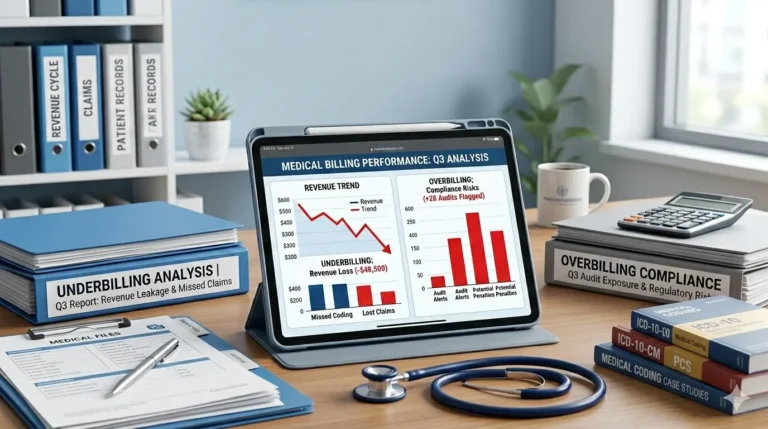
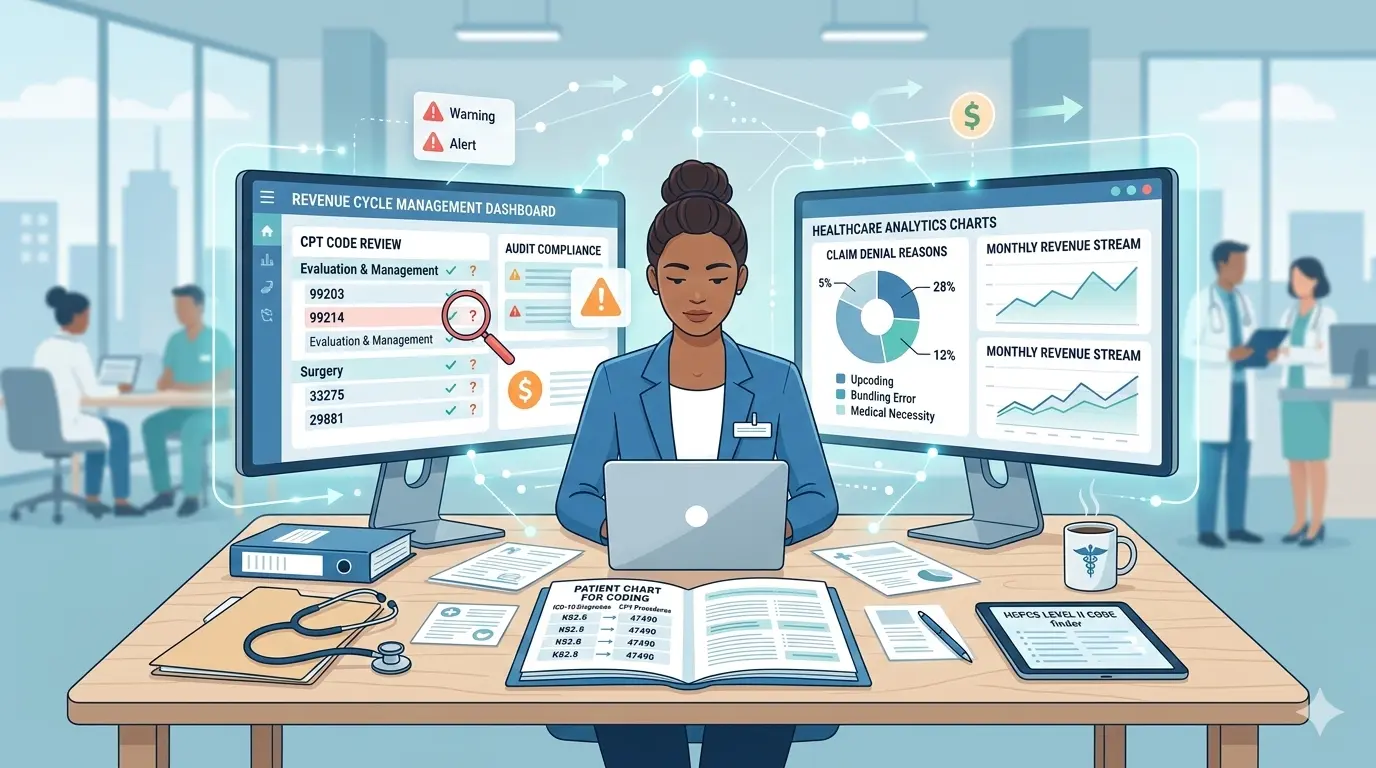
In today’s highly regulated U.S. healthcare system, CPT coding mistakes are one of the leading causes of payer audits, claim denials, revenue delays, and compliance penalties. If you’re wondering, “What CPT coding errors trigger audits?” , the answer often includes upcoding, modifier misuse, unbundling, outdated codes, and documentation mismatches. With constantly evolving rules from the Centers for Medicare & Medicaid Services (CMS), stricter National Correct Coding Initiative (NCCI) edits, and AI-powered insurance claim monitoring systems, even small CPT errors can lead to payment recoupments or full-scale audits.
At Ebillient, our medical billing and coding services help healthcare providers across the United States reduce coding risks, strengthen compliance, and increase clean claim rates. In this comprehensive guide, we explain the 15 most common CPT coding mistakes that trigger audits, and how your practice can prevent them to protect revenue and stay audit-ready.
Why CPT Coding Accuracy Matters More Than Ever
The Centers for Medicare & Medicaid Services (CMS) and private insurers use advanced data analytics to detect billing irregularities. Meanwhile, guidance from the American Medical Association (AMA), which maintains CPT codes, changes annually, making ongoing education essential.
Audit triggers typically include:
- Repeated high-level E/M billing
- Modifier misuse
- Unbundling services
- Invalid or outdated CPT codes
- Mismatch between diagnosis and procedure
If your coding patterns deviate from specialty benchmarks, you may be flagged automatically.
Let’s explore the top mistakes.
1. Upcoding (Billing for a Higher-Level Service)
What it is: Reporting a more complex CPT code than the service provided.
Example: Billing 99215 when documentation supports 99213.
Why it triggers audits: Payers analyze E/M distribution patterns. Consistently billing top-level codes raises red flags.
How to prevent it:
- Ensure documentation supports medical decision-making complexity.
- Conduct quarterly internal audits.
- Follow CMS E/M guidelines carefully.
2. Undercoding
While less likely to trigger audits, undercoding leads to major revenue loss.
Common cause: Fear of audits.
Impact: Lost revenue, undervaluing provider services, inaccurate reporting.
Solution: Train coders to code accurately, not defensively.
3. Unbundling CPT Codes
Unbundling occurs when a provider bills separately for procedures that should be billed under a single comprehensive code.
Example: Billing lesion removal and simple repair separately when repair is included.
The Centers for Medicare & Medicaid Services NCCI edits automatically detect these errors.
Prevention:
- Review NCCI edits regularly.
- Use claim-scrubbing software.
- Train coders on bundled services.
4. Ignoring NCCI Edits
The National Correct Coding Initiative (NCCI) prevents improper payments.
If you bill two codes that conflict under NCCI rules, one will be denied—or worse, flagged for review.
Best practice:
Always verify whether a modifier is allowed before overriding an edit.
5. Modifier Misuse (Especially -25, -59, -50)
Modifiers explain circumstances around procedures. Incorrect usage is a top audit trigger.
Common mistakes:
- Using -25 without documentation of significant, separately identifiable E/M service.
- Overusing -59 to bypass bundling edits.
- Incorrect bilateral reporting with -50.
The Office of Inspector General (OIG) has repeatedly identified modifier misuse as a compliance risk.
Prevention Tips:
- Audit modifier frequency monthly.
- Document thoroughly before applying.
- Stay updated with payer-specific rules.
6. Overusing Modifier 22 (Increased Procedural Services)
Modifier 22 requires clear documentation showing substantial extra work.
Audit risk: Without strong documentation, payers may deny or review claims.
Fix:
- Include operative notes detailing complexity.
- Compare time and effort to typical cases.
7. Using Outdated or Deleted CPT Codes
Each year, the American Medical Association updates CPT codes.
Billing a deleted code results in instant denial.
Prevention:
- Update billing software annually.
- Conduct yearly CPT training.
- Subscribe to AMA and CMS updates.
8. Incorrect Time-Based Coding
Time-based codes (e.g., prolonged services, infusions) require precise start and stop times.
Audit trigger: Missing time documentation.
Solution:
- Document total time clearly.
- Avoid rounding.
- Verify payer rules for minimum time thresholds.
9. Reporting Unlisted Codes Without Documentation
Unlisted CPT codes require strong supporting documentation and comparison to similar procedures.
Risk: High likelihood of manual review.
Best Practice:
- Attach operative reports.
- Include rationale and comparable CPT references.
10. Duplicate Billing
Submitting the same CPT code twice for the same encounter is a common audit trigger.
Prevention:
- Track claim resubmissions carefully.
- Use automated duplicate detection tools.
11. Diagnosis–Procedure Mismatch
If the ICD-10 diagnosis does not justify the CPT procedure, medical necessity denial occurs.
The Centers for Medicare & Medicaid Services frequently cites lack of medical necessity as a top denial reason.
Prevention:
- Validate CPT–ICD alignment.
- Use medical necessity checking tools.
12. Failure to Code to Highest Specificity
Using vague CPT codes when specific ones exist raises scrutiny.
Example: Using general procedure codes instead of specialty-specific updates.
Fix:
- Always code to highest specificity supported by documentation.
- Educate providers on detailed charting.
13. Incorrect E/M Level Selection
Since E/M guidelines changed, selection must be based on:
- Medical decision-making
- Total time (when applicable)
Incorrect leveling is a major audit hotspot.
Recommendation: Conduct E/M audits twice yearly.
14. Not Querying Providers for Clarification
If documentation is unclear, coders must query providers.
Skipping clarification leads to:
- Underbilling
- Overbilling
- Denials
Strong communication reduces risk significantly.
15. Lack of Internal Auditing & Compliance Monitoring
Even good coders make mistakes without oversight, which is why regular billing and coding audits are essential to identify errors early and maintain compliance.
Best Practices:
- Monthly random claim reviews.
- Quarterly compliance audits.
- Ongoing coder education.
- Benchmarking against specialty averages.
The Financial Impact of CPT Coding Errors
Without proper revenue cycle management services, CPT errors can cause:
- Increased claim denials
- Payment delays
- Recoupments
- Civil monetary penalties
- Full-scale payer audits
For many practices, coding mistakes cost $25,000+ per provider annually in lost revenue and rework.
How Ebillient Helps You Prevent CPT Audit Triggers
At Ebillient, we specialize in:
Certified CPT coding review
E/M leveling audits
Modifier validation
NCCI edit compliance
Real-time claim scrubbing
Denial management
Revenue cycle optimization
Our proactive approach ensures:
- Higher clean claim rates
- Reduced audit risk
- Faster reimbursements
- Improved compliance confidence
We don’t just fix errors—we build systems that prevent them.
Final Thoughts
CPT coding isn’t just about reimbursement. It’s about:
- Compliance
- Risk mitigation
- Accurate reporting
- Financial stability
With payers using advanced analytics and AI-driven audit systems, precision is no longer optional, it’s essential.
If your practice wants to reduce denials, prevent audits, and maximize reimbursement, it’s time to partner with experts.