

Medical billing is the work of preparing claims, submitting them to payers, and following up until they are paid. Revenue cycle management (RCM) is the larger process that follows a patient account from registration through final payment. Billing is generally one part of RCM, although some companies use the two terms loosely or bundle them differently.
For a practice, the distinction matters because it points to the right fix. A problem with individual claims calls for billing support. A pattern of problems across intake, documentation, and collections calls for a wider look at the revenue cycle.
Medical Billing vs Revenue Cycle Management: What’s the Difference?
The difference is scope. Medical billing focuses on turning a completed patient visit into a claim and getting that claim paid. RCM covers everything that affects whether the practice gets paid correctly, including steps that happen before the visit and after the claim is submitted.
The Healthcare Financial Management Association (HFMA) describes revenue cycle management as all administrative and clinical functions that contribute to the capture, management, and collection of patient service revenue. That definition shows why RCM reaches into front desk, clinical documentation, and finance work, not just the billing desk.
Vendors package their services differently. One medical billing company may handle only claims and payment posting. Another may include eligibility checks, denial work, and reporting under the same label. Always compare the actual task list, not the name of the service.
What Is Medical Billing?
Medical billing converts the care a provider delivered into a claim that a payer can process. It depends on accurate codes, correct patient and insurance data, and timely submission. Practices that want outside help with this work can review Ebillient’s medical billing and coding services.
Core Medical Billing Responsibilities
- Entering and verifying charges from the encounter
- Applying diagnosis and procedure codes supported by documentation
- Creating and submitting claims to payers
- Posting payments and adjustments
- Billing patients for their share after insurance pays
- Following up on unpaid or rejected claims
How Medical Billing Supports Claims and Reimbursement
A claim is only as good as the information behind it. Billing staff check that codes match the documentation, that modifiers are applied where payer rules require them, and that the claim meets the payer’s format and timing requirements. Many practices also use claim scrubbing software to catch obvious errors before submission.
Requirements vary by payer, specialty, and contract. Medicare rules, for example, differ from those of many commercial plans, so billing teams need to work from current payer policies.
Common Problems Medical Billing Teams Handle
- Rejected claims caused by data errors, such as a wrong subscriber ID
- Denials tied to missing modifiers or unsupported codes
- Late claims that miss payer filing limits
- Underpayments that need to be compared against contract terms
- Patient balances that are unclear or incorrect
What Is Revenue Cycle Management (RCM)?
RCM is the full financial lifecycle of a patient account. It begins when a patient schedules care and ends when the balance is fully resolved. Billing sits at the center of that cycle, but it is not the whole cycle. Practices exploring this approach can read about Ebillient’s revenue cycle management services.
Key Stages of the Revenue Cycle
The stages are commonly grouped into three phases. Exact labels differ across organizations, so treat this as a practical model, not a fixed standard.
- Front end (before the visit): scheduling, registration, insurance eligibility verification, and prior authorization when required.
- Mid cycle (during and just after the visit): clinical documentation, coding, and charge capture.
- Back end (after the claim goes out): claim submission, payment posting, denial management, A/R follow up, patient collections, and account resolution.
How RCM Connects Administrative, Clinical, and Financial Work
Revenue problems often start outside the billing office. A front desk error in insurance details, a provider note that does not support the service billed, or a missed authorization can all cause a denial weeks later. RCM treats these as connected parts of one process, so root causes get fixed where they begin instead of being corrected claim by claim.
Medical Billing vs RCM: Key Differences at a Glance
| Area | Medical Billing | Revenue Cycle Management |
| Scope | Claims and payment work | Full patient account lifecycle |
| Main objective | Submit accurate claims and get them paid | Capture, manage, and collect revenue accurately across all stages |
| Typical responsibilities | Charge entry, coding, claim submission, payment posting | Billing tasks plus registration, eligibility, authorization, documentation review, denial analysis, reporting |
| Front end involvement | Usually limited or none | Usually included or coordinated |
| Claims and payment processing | Core function | One component of the cycle |
| Denials and A/R | Handles individual denials and follow up | Adds root cause analysis and prevention |
| Reporting | May be basic claim and payment reports | Often includes trends by payer, denial reason, and A/R aging |
| Typical need | Practices with sound front end processes that need claim capacity | Practices with recurring issues across several stages |
This table describes common patterns, not a guarantee. Providers differ, so confirm in writing what any vendor actually includes.
Where Medical Billing Fits Within the Revenue Cycle
A simplified workflow looks like this:
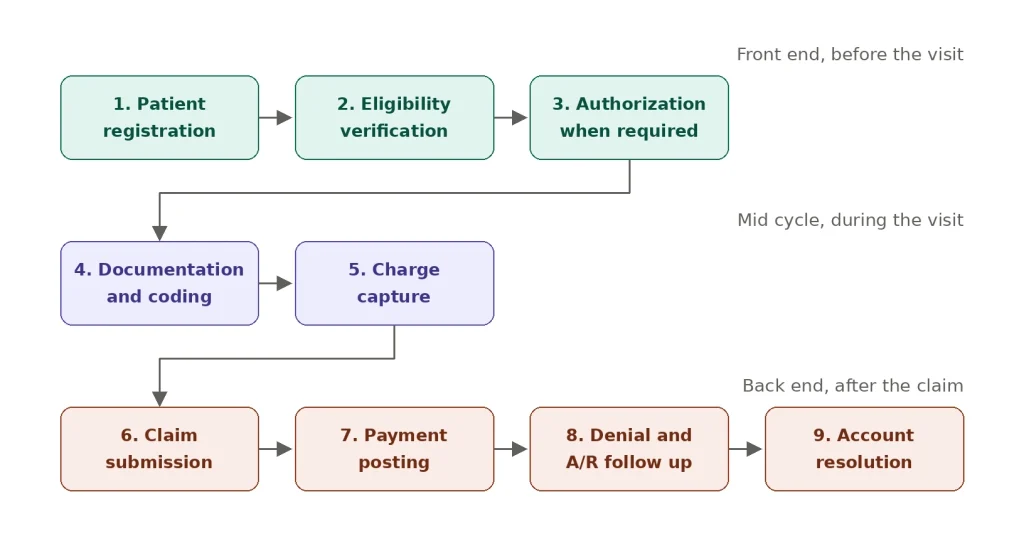
Medical billing most directly covers charge capture through payment posting and follow up. RCM includes every step plus the coordination between them. Actual workflows vary by specialty, payer, organization size, and service arrangement. A surgical practice, for example, may have authorization steps that a small primary care office rarely needs.
Medical Billing Problems vs. Revenue Cycle Problems
The key question is whether a problem is isolated or recurring. A single error is a billing issue. The same error appearing again and again points to a process gap.
Signs of a Medical Billing Problem
- A claim was rejected because of a typo in a member ID, then paid after correction
- Claims go out late because billing staff are behind
- Payments are posted incorrectly or patient statements contain errors
- Specific codes or modifiers are being applied wrongly
Signs of a Wider Revenue Cycle Problem
- The same denial reasons keep appearing month after month
- Many denials trace back to eligibility or authorization, not coding
- A/R keeps aging even though claims are submitted on time
- Nobody can say which payers or denial types cost the practice the most
- Documentation regularly fails to support the codes billed
When the cause sits upstream of the claim, better billing alone will not solve it. Industry groups such as MGMA recommend using revenue cycle analytics to pinpoint the leading causes of denials in physician practices.
Examples of Problems That Require Both Functions
Inactive coverage: A patient’s coverage ended before the visit, and the claim is denied. Billing can bill the patient or find new coverage, but only a stronger eligibility check at scheduling prevents the next one.
Missing authorization: A procedure required prior authorization that was never obtained. Billing cannot fix this after the fact. The authorization workflow has to change, and billing then handles any appeal.
Weak documentation: Provider notes do not support the level of service billed. Coders may need to adjust codes to stay compliant, which lowers payment. The fix involves provider education and documentation review along with accurate coding.
How RCM Can Improve Medical Billing Performance
Claims perform better when the work before them is sound. RCM tightens each link in the chain:
- Registration and eligibility: Accurate demographics and verified coverage reduce avoidable rejections.
- Authorization: Tracking which services need approval, and getting it before the visit, prevents denials that billing cannot reverse.
- Documentation and coding: Notes that support the codes billed reduce denials and compliance risk.
- Claim submission and posting: Timely, clean submission and accurate posting keep data reliable.
- Denial analysis and A/R follow up: Tracking denial reasons turns one off fixes into lasting corrections.
Results depend on the practice, its payer mix, and how well processes are carried out. No vendor can honestly guarantee a specific improvement in collections or denial rates.
Medical Billing vs RCM: Which Does Your Practice Need?
When Specialized Medical Billing Support May Be Enough
- Your front desk and clinical documentation are generally reliable
- Denials are occasional and have varied causes
- You mainly need help with claim volume, follow up, or staffing gaps
- You already have internal reporting that you trust
When Broader RCM Support May Be Appropriate
- Denials repeat for the same reasons
- Authorization, eligibility, or coding issues span several staff roles
- You lack clear visibility into A/R aging and payer performance
- You are adding providers, locations, or specialties
- Internal staff are overextended across several revenue tasks
Questions to Ask Before Outsourcing
- What share of our denials trace back to registration, eligibility, or authorization?
- Do we have the staff and tools to analyze denial trends ourselves?
- Which tasks do we want to keep in house?
- What reports do we need to see, and how often?
- Who owns follow up when a claim is denied for a front end reason?
If most answers point to isolated issues, billing support may fit. If they point to gaps across the cycle, RCM deserves a closer look.
How to Choose a Medical Billing or RCM Partner
- Service scope: Get a written list of what is and is not included, since terms vary widely.
- Specialty experience: Ask how the team handles your specialty’s coding, modifiers, and payer rules.
- Reporting: Ask which metrics you will receive, such as A/R aging, denial rates by reason, and payer performance, and how often.
- Communication: Confirm who your contact is and how issues are escalated.
- Denial workflow: Ask how denials are tracked, appealed, and fed back into prevention.
- Data security: Because the vendor will handle protected health information, ask about HIPAA safeguards and a business associate agreement.
- Implementation: Ask how onboarding works and how your EHR or practice management system will be used.
- Contract terms: Review pricing structure, notice periods, and who owns your data if you leave.
- Performance measurement: Agree in advance on how success will be measured, and be cautious of guaranteed outcomes.
Frequently Asked Questions
Is medical billing part of revenue cycle management?
Yes. Billing is one function within the broader revenue cycle, which also includes registration, eligibility, documentation, coding, and collections.
What is RCM in medical billing?
It refers to the full process of managing a patient account’s financial lifecycle, from scheduling to final payment, with billing as a core component.
What are the main stages of the revenue cycle?
Commonly: registration, eligibility verification, authorization when required, documentation and coding, charge capture, claim submission, payment posting, denial and A/R follow up, and account resolution.
Can a medical billing company provide full RCM services?
Some can, and some cannot. Many billing companies also offer eligibility, denial management, and reporting, but scope varies, so ask for a written service list.
Should a small medical practice outsource billing or RCM?
It depends on where problems occur. If issues are limited to claims and follow up, billing support may be enough. If problems start at intake or documentation, broader RCM support may fit better.
Final Thoughts
Medical billing vs revenue cycle management comes down to scope. Billing moves claims toward payment. RCM manages every step that affects whether that payment is correct and complete. Start by looking at your denial patterns, A/R aging, and where errors originate, then choose support that matches what you find.
If you would like help evaluating your workflow, Ebillient MedRevenue can review your current setup and discuss whether medical billing support or broader revenue cycle support fits your practice.