Medicaid billing follows the same basic path as other payers, but the details change by state and by health plan. A claim that is paid in one program can be rejected in another because of an enrollment gap, a missing authorization, or a filing deadline.
This guide walks through the full Medicaid billing process, from provider enrollment to compliance. Use it as a framework, then confirm the specifics in your state Medicaid agency’s provider manual and in your managed care plan contracts.
What Is Medicaid Billing and How Does It Work?
Medicaid billing is the process of submitting claims to a state Medicaid program, or to a Medicaid managed care plan, for covered services provided to eligible patients. Providers who participate generally accept the Medicaid payment as payment in full and cannot bill the patient for the difference, apart from any allowed copayments.
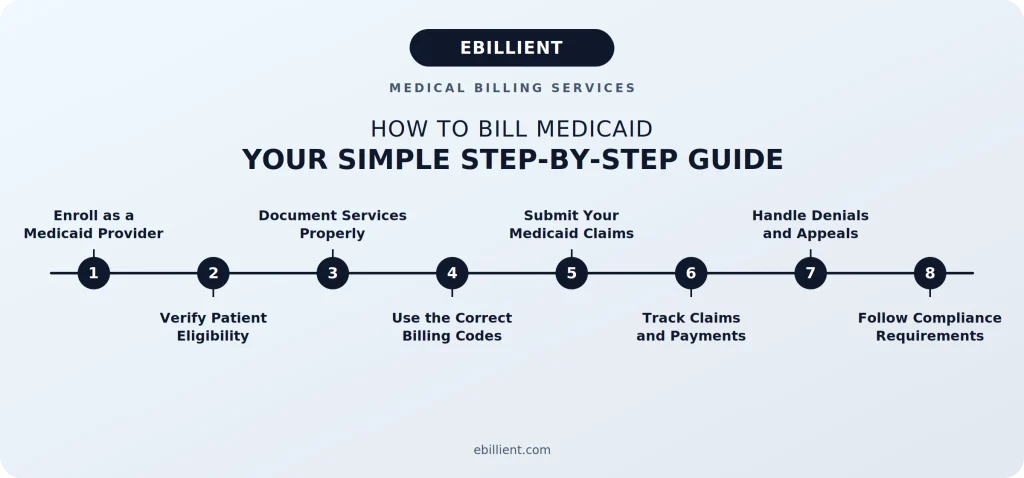
The process is straightforward in outline. You enroll, verify eligibility, document care, code the services, submit the claim, track payment, and manage denials. Each step has state rules that affect whether the claim gets paid.
Understanding Medicaid Coverage
Medicaid is a joint federal and state program that covers health care for eligible low-income individuals, families, children, pregnant women, older adults, and people with disabilities. Federal rules set a framework, but states run their own programs.
Covered services, provider types, and payment methods differ across programs. Medicaid is also generally the payer of last resort, so if a patient has other insurance, that coverage is usually billed first.
How Medicaid Billing Differs by State
Each state Medicaid agency sets its own enrollment process, fee schedules, covered services, prior authorization rules, and claim submission requirements. Filing deadlines and appeal timelines also vary.
Never assume that one state’s rules apply in another. Treat your state’s provider manual, billing guides, and bulletins as your primary reference.
Medicaid Fee-for-Service vs. Managed Care
In fee-for-service, the state Medicaid agency pays providers directly for covered services. In Medicaid managed care, the state contracts with health plans that manage benefits and pay claims, and many beneficiaries receive care this way.
Managed care plans often have their own provider networks, credentialing, authorization rules, portals, and appeal processes. You must follow both the state program rules and the specific plan’s requirements.
Step 1: Enroll as a Medicaid Provider
You generally cannot bill Medicaid until you are enrolled and approved. Enrollment confirms that you are licensed, eligible to participate, and screened under federal and state requirements. If you want help with applications and plan contracting, Ebillient offers provider credentialing and enrollment support.
Check Your State’s Medicaid Enrollment Requirements
Start with your state Medicaid agency’s provider enrollment page. Confirm which provider types are eligible, which application you need, and whether enrollment is handled through a state portal or a fiscal agent.
If you plan to serve patients in managed care, find out whether you must also credential with each plan separately. Enrollment in the state program does not always mean you are in a plan’s network.
Gather the Required Provider Documents
Requirements vary, but applications commonly ask for the following:
- National Provider Identifier (NPI)
- State license and any required certifications
- Taxpayer identification number and W-9 information
- Practice location, ownership, and contact details
- Banking details for electronic payments
- Malpractice insurance information, where required
- Disclosures about ownership and exclusions, where required
Tip: Make sure your NPI, taxonomy code, and addresses match across all of your applications. Mismatches are a common cause of enrollment delays and later claim problems.
Complete and Submit Your Enrollment Application
Complete every field and attach the requested documents. Incomplete applications are often returned or delayed.
Some provider types may be subject to additional screening, site visits, fingerprinting, or application fees, depending on the risk category and state rules. Keep a copy of everything you submit.
Confirm Your Enrollment and Provider Information
After approval, you should receive a Medicaid provider ID or confirmation of your effective date. Check that your name, locations, specialties, and billing details are listed correctly.
Federal rules require states to revalidate provider enrollment periodically, so track your revalidation date. Letting enrollment lapse can lead to denied claims.
Step 2: Verify Medicaid Patient Eligibility
Medicaid eligibility can change from month to month. Consistent eligibility verification before each visit helps prevent one of the most avoidable causes of denials.
Check Active Coverage Before the Appointment
Use your state Medicaid eligibility portal, the electronic eligibility transaction, or the method your state supports. Verify coverage on the date of service, not only at the patient’s first visit.
Record the verification date, the coverage status, and any limits shown. Ask patients to bring their current Medicaid ID and any other insurance cards.
Confirm the Patient’s Managed Care Plan
An active Medicaid ID does not tell you who pays the claim. Eligibility responses often show whether the patient is in fee-for-service or enrolled in a managed care plan.
If the patient is in a plan, bill the plan, not the state agency. Also check whether you are in network and whether the patient has a primary care assignment or referral requirement.
Review Covered Services and Authorization Requirements
Coverage of a patient does not guarantee coverage of a service. Check whether the service is covered, whether limits apply, and whether prior authorization is required.
Examples include visit limits, specialty services, imaging, durable medical equipment, and certain procedures. Document any authorization number so it can be added to the claim.
Tip: If the patient has other insurance, confirm the primary payer and billing order before you submit to Medicaid.
Step 3: Document Medical Services Properly
Medicaid claims are only as strong as the documentation behind them. Clear records support medical necessity, correct coding, and a defense during audits.
Record Diagnoses, Treatments, and Medical Necessity
Each note should clearly show why the service was needed, what was done, and how it relates to the patient’s condition. The diagnosis, assessment, and plan should support one another.
Avoid vague entries. A note that explains the clinical reasoning is far more useful than one that lists a procedure without context.
Maintain Supporting Medical Records
Keep signed and dated notes, orders, test results, referrals, consent forms, and authorization records. Supporting records should be easy to retrieve if a payer requests them.
Retention periods vary by state and program, so check the requirement that applies to your practice rather than relying on a general rule.
Check Documentation Before Billing
Before a claim is released, confirm that the note is complete and signed, the date of service and provider are correct, and the documentation supports every code billed. For time based or unit based services, make sure the record shows the time or quantity.
Tip: A short documentation review before billing is faster than correcting claims later.
Step 4: Use the Correct Medical Billing Codes
Accurate Medicaid billing and coding translates the care you provided into the standardized codes payers use to process claims. Errors here lead directly to denials and underpayments.
Select the Appropriate CPT and HCPCS Codes
CPT codes describe most professional services, while HCPCS Level II codes cover items such as supplies, certain drugs, and equipment. Choose codes based on the documentation, not on what is likely to pay more.
Some Medicaid programs use state specific codes or have unique rules for certain services. Check your state’s fee schedule and billing guidance for the codes you use most.
Assign Accurate ICD-10-CM Diagnosis Codes
Diagnosis codes should reflect the patient’s condition to the highest level of specificity supported by the record. The diagnosis must also support the medical necessity of the service billed.
Link each procedure to the appropriate diagnosis and follow the claim’s diagnosis pointer rules. Unspecified codes can trigger edits or denials for some services.
Apply Modifiers and Units When Required
Modifiers add detail about how a service was performed, such as a separate procedure or a service by a specific provider type. Units tell the payer how much of a service was provided.
Medicaid programs may have their own modifier rules and unit definitions. Always check the current guidance before applying them.
Avoid Common Medicaid Coding Errors
Frequent problems include:
- Using outdated or deleted codes
- Missing or incorrect modifiers
- Diagnosis codes that do not support the service
- Incorrect units
- Billing services that are not covered or need authorization
Tip: Update your code sets and review your state’s bulletins when annual code changes take effect.
Step 5: Submit Your Medicaid Claims
Once coding is complete, the claim must be prepared and sent in the format and manner your Medicaid program requires.
Prepare the Claim With Accurate Patient and Provider Details
Professional claims are typically submitted on the CMS-1500 form or its electronic equivalent, the 837P transaction. Institutional claims generally use the UB-04 or the 837I.
Double check these details before submitting:
- Patient name, date of birth, and Medicaid ID exactly as shown in the eligibility response
- Billing and rendering provider NPI and Medicaid provider ID
- Date of service and place of service
- Procedure codes, modifiers, units, and diagnosis codes
- Prior authorization number, if applicable
- Other insurance information and primary payer payment details
Submit Claims Through the Appropriate Portal or Clearinghouse
Fee-for-service claims are usually submitted through the state’s portal or fiscal agent, often directly or through a clearinghouse. Managed care claims go to the health plan, using its portal or its designated clearinghouse and payer ID.
Confirm the correct destination for each patient. Sending a claim to the wrong payer can cause delays and may put you at risk of missing the filing deadline.
Review Claim Requirements Before Submission
Check timely filing limits, attachment requirements, and any special rules for the service. Federal Medicaid regulations set an outer limit on how long states may allow for claim submission, but states and plans can set shorter windows, so verify your own deadline.
Tip: Use a claim scrubber to catch missing fields, invalid codes, and basic edits before the claim leaves your office.
Understand Electronic Claims and Paper Claim Options
Electronic submission is generally faster and allows quicker acknowledgments, status checks, and error reports. Many programs strongly prefer or require electronic claims.
Paper claims may still be accepted in limited situations, such as certain attachments or exceptions. Check your program’s rules before using paper, since processing is usually slower.
Step 6: Track Medicaid Claims and Payments
Submitting a claim is not the end of the process. Active tracking helps you find problems early, while there is still time to fix them.
Check Claim Status Through the Provider Portal
Confirm that each claim was accepted after submission. Then use the portal or the claim status transaction to see whether it is pending, paid, denied, or rejected.
Set a regular schedule for checking claims, rather than waiting until payments are overdue.
Review Remittance Advice and Payment Details
The remittance advice, often delivered as an electronic 835, explains what was paid, adjusted, or denied. Review the claim adjustment and remark codes so you understand the reasoning behind each decision.
Compare payments against the fee schedule or contracted rate for the service. Underpayments can go unnoticed if no one reviews the details.
Follow Up on Delayed or Unpaid Claims
Federal rules set prompt payment standards for state Medicaid agencies, and managed care contracts have their own timeliness terms. Actual processing times vary by program and claim type.
If a claim is outside the expected timeframe, check the status first, then contact the payer with the claim number and date of submission. Keep notes on every contact.
Step 7: Handle Medicaid Claim Denials and Rejections
Denials are a normal part of Medicaid billing, but most are preventable. A structured response, or professional denial management support, keeps revenue from being lost.
Understand the Difference Between a Rejected and Denied Claim
A rejected claim has not been accepted for processing, usually because of a format or data error such as a missing field or an invalid ID. It can often be fixed and resubmitted as a new claim.
A denied claim was processed and refused payment for a specific reason, such as no eligibility or no authorization. It generally requires correction or an appeal, depending on the cause.
Identify Common Reasons for Medicaid Claim Denials
Common causes of Medicaid claim denials include:
- Patient not eligible on the date of service
- Billing the wrong payer, such as the state instead of the managed care plan
- Missing prior authorization
- Provider not enrolled or not in network
- Invalid codes, modifiers, or diagnosis linkage
- Duplicate claims
- Other insurance not billed first
- Claims filed after the timely filing deadline
Correct Errors and Resubmit Claims
Read the denial reason and remark codes, then determine whether the issue was a billing error or a payer decision. Fix the underlying error, and follow your payer’s rules on corrected claims or resubmissions.
Track the cause of each denial. Patterns show you where to improve front end processes.
File an Appeal Within the Applicable Deadline
If you believe a denial is incorrect, file an appeal or dispute according to your state program or managed care plan procedures. Deadlines and required formats vary, and they can be short.
Include the claim details, the denial notice, and supporting documents such as medical records and authorization proof. Note the filing deadline as soon as the denial arrives.
Step 8: Follow Medicaid Billing Compliance Requirements
Medicaid is a publicly funded program, so providers are held to strict program integrity standards. Compliance protects both your payments and your participation status.
Keep Up With State Medicaid Policy Updates
Medicaid policies, fee schedules, and coding rules change over time. Subscribe to provider bulletins and notices from your state agency and each managed care plan you work with.
Assign someone in your practice to review updates and share changes with clinical and billing staff.
Maintain Accurate Records and Audit Claims
Periodic internal audits help you find coding, documentation, and billing issues before an outside reviewer does. Sample claims across providers and services, and fix patterns that appear.
Keep records for the period your state and program require. Be prepared to respond to record requests from the state, managed care plans, or audit programs.
Follow Documentation, Privacy, and Billing Rules
Protect patient information under HIPAA, and only bill for services that were provided, documented, and medically necessary. Billing for services not rendered, upcoding, or unbundling can raise serious compliance and legal concerns.
Check that providers and staff are screened against the OIG exclusion list as required, and train your team on current rules.
Common Medicaid Billing Mistakes to Avoid
Many Medicaid billing problems come from small process gaps. The most common ones include:
- Skipping eligibility checks on the date of service
- Assuming the patient is in fee-for-service when they are in managed care
- Failing to get prior authorization
- Billing with outdated provider or enrollment details
- Using codes that the documentation does not support
- Ignoring other insurance and coordination of benefits
- Missing timely filing deadlines
- Not reading remittance advice or following up on denials
- Letting enrollment or revalidation lapse
Most of these can be reduced with a clear workflow and regular staff training.
How Can Healthcare Providers Improve Their Medicaid Billing Process?
Improving Medicaid reimbursement is mostly about consistency. Strong front end processes, good tools, and regular monitoring work better than fixing problems one claim at a time.
Create a Consistent Eligibility Verification Workflow
Verify eligibility at scheduling and again close to the visit. Record the plan, the other insurance, and any authorization needs in the patient account.
A standard checklist helps front desk staff handle every patient the same way.
Use Reliable Billing Software and Claim Scrubbing Tools
Good billing software can flag missing data, invalid codes, and payer specific edits before submission. It also helps with electronic claims, remittance posting, and reporting.
Choose tools that can be updated with your state’s and plans’ requirements.
Monitor Denials and Accounts Receivable
Review denial rates, top denial reasons, and aging accounts receivable on a regular schedule. Break results down by payer, provider, and service.
When you see a pattern, fix the root cause, not just the claim.
Consider Professional Medical Billing Support
Medicaid billing can be time consuming, especially when you manage several states or plans. Some practices work with a medical billing company to support enrollment follow up, eligibility checks, claim submission, and denial management.
Ebillient provides medical billing services that can help practices manage Medicaid claims alongside other payers, so internal staff can focus on patient care and front office tasks.
Medicaid Billing Checklist for Healthcare Providers
Use this checklist as a quick reference, and adjust it to your state and plans.
Before the visit
- Confirm Medicaid enrollment and any plan credentialing are active
- Verify patient eligibility for the date of service
- Identify the fee-for-service or managed care payer
- Check covered services and authorization needs
- Identify other insurance
At the visit and after
- Document the diagnosis, treatment, and medical necessity
- Complete and sign notes
- Assign accurate CPT, HCPCS, and ICD-10-CM codes
- Apply modifiers and units correctly
Claim and payment
- Check patient and provider details on the claim
- Run the claim through a scrubber
- Submit to the correct payer within the filing deadline
- Confirm claim acceptance
- Review remittance advice and post payments
Follow up and compliance
- Work denials and rejections promptly
- Track appeal deadlines
- Review state and plan updates
- Audit claims and keep records for the required period
Frequently Asked Questions About Medicaid Billing
How do you bill Medicaid as a healthcare provider?
First, enroll with your state Medicaid program and any managed care plans you serve. Then verify patient eligibility, document the service, assign accurate codes, and submit the claim to the correct payer. Track payment, review remittance advice, and correct or appeal denials. Follow your state and plan rules throughout.
Can providers submit Medicaid claims electronically?
Yes. Most Medicaid programs and managed care plans accept electronic claims, often through a state portal, fiscal agent, or clearinghouse. Many prefer or require them because they are processed faster and allow easier tracking. Check your program’s rules, since some situations may still allow or require paper claims.
What information is required for a Medicaid claim?
A claim typically needs the patient’s name, date of birth, and Medicaid ID, plus the billing and rendering provider details and NPI. It also includes the date and place of service, CPT or HCPCS codes, ICD-10-CM codes, modifiers, units, charges, and any authorization or other insurance information. Requirements vary by program.
Why are Medicaid claims denied?
Common reasons include inactive eligibility, billing the wrong payer, missing prior authorization, provider enrollment problems, coding errors, duplicate claims, and unbilled other insurance. Claims filed after the timely filing deadline are also denied. Reviewing the remittance advice codes will show the specific reason for each denial.
How long does Medicaid take to pay a claim?
It depends on the state, the program, the plan, and whether the claim is clean. Federal rules set prompt payment standards for state Medicaid agencies, and managed care contracts have their own terms. Errors, missing information, and reviews can add time, so check your program’s published timeframes.
Does every state have the same Medicaid billing rules?
No. States operate their own Medicaid programs within federal guidelines. Enrollment steps, covered services, authorization rules, claim formats, filing deadlines, and appeal processes can all differ. Managed care plans add another layer of requirements, so always rely on your state’s provider manual and plan contracts.
Can a medical billing company handle Medicaid claims?
Yes. A medical billing company can support Medicaid claim preparation, submission, payment posting, and denial follow up, subject to your state’s rules and your agreements. You remain responsible for accurate documentation and compliance, so choose a partner that understands Medicaid and communicates clearly.
Conclusion
Learning how to bill Medicaid comes down to a repeatable process. Enroll correctly, verify eligibility and the responsible payer, document and code accurately, submit clean claims on time, and follow up on every payment and denial. Because rules differ by state and by plan, the official provider manuals should always guide your final decisions.
If your practice needs help with Medicaid claims, eligibility checks, or denial follow up, Ebillient’s medical billing services team can support your workflow. Contact Ebillient to discuss your practice’s billing needs and find out how professional Medicaid billing support could fit your organization.